
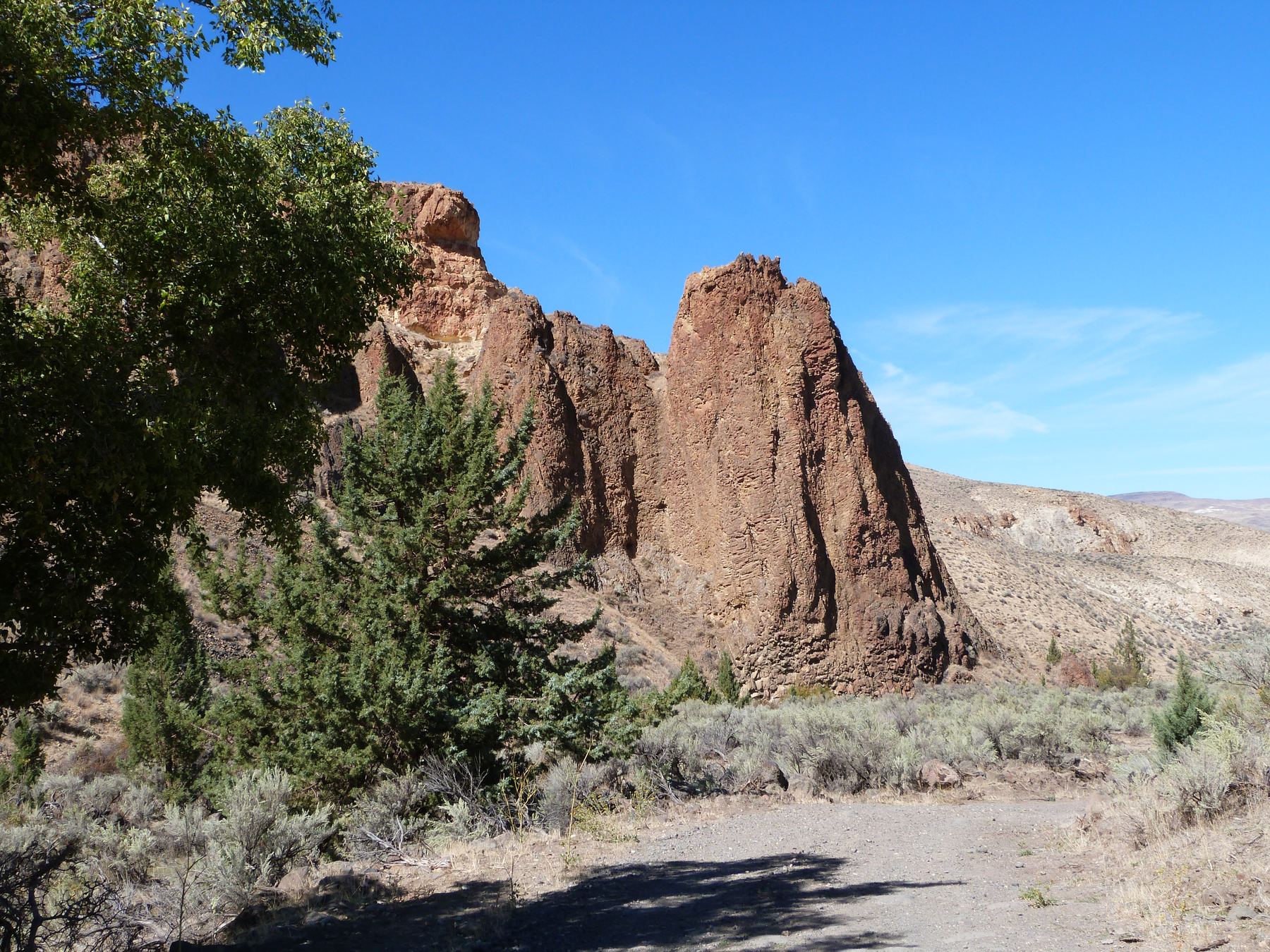
Most people drive through the Owyhee looking at the canyons. Rockhounds look at the ground — because this volcanic country is one of the richest rock-collecting regions in the Northwest, and the best part is that you can walk away with a bucketful, legally and without paying a dime.
The Owyhee canyonlands were built by ancient eruptions. All that volcanic rhyolite, tuff, and ash left behind gas pockets and beds that filled, over millions of years, with silica — which is to say with thundereggs, agate, jasper, and petrified wood, by the millions. Jordan Valley sits right at the doorstep of it. This guide covers the part that trips up newcomers: what's actually legal to collect, where to go, what you'll find, and how to do it without damaging the land or breaking federal law.
Is it legal? Mostly yes — here's the honest answer
On the BLM-managed public land that makes up most of the Owyhee, recreational rockhounding for your own collection is allowed without a permit and without a fee. The rule comes from a federal regulation (43 CFR 8365.1-5) that lets the public collect reasonable amounts of rocks, mineral specimens, and semiprecious gemstones for non-commercial use. "Non-commercial" just means you're collecting for yourself — not to resell for a business.
For Oregon, the BLM puts numbers on "reasonable": you can collect up to 25 pounds per day plus one larger single piece, not to exceed 250 pounds in a year, per person. That covers minerals, gemstones, petrified wood, common fossils, and other rock all together. A group can't pool their yearly allowances to haul off one giant boulder — for anything over 250 pounds you have to call the local BLM office first.
The catch: it depends on whose land you're on
The 25-pound rule is BLM land. But the Owyhee is a patchwork, and the rules change with the boundary line — which is almost never marked on the ground. A few things to keep straight:
- Succor Creek State Natural Area is the most famous local thunderegg spot — and it's state-park land, not BLM. The state allows souvenir collecting but holds you to a much smaller limit: one gallon per person per day, three gallons per year. As you drive Succor Creek Road you cross in and out of state and BLM land, so the rule you're under depends on exactly where you're digging.
- Active mining claims are scattered through the public land. You can't collect on someone's claim without their permission, even if it looks like open desert.
- Private ranch land fills a lot of the valley bottoms. No collecting without the owner's okay.
- The Owyhee Reservoir shoreline falls partly under the Army Corps of Engineers, where collecting is prohibited — so stick to the surrounding BLM ground, not the reservoir margin itself.
One question we get a lot: isn't the Owyhee a national monument now? As of 2026, no. There have been years of effort to protect the canyonlands — a bill in Congress, a push for a presidential monument declaration — but the most recent attempt stalled at the end of 2024 and nothing has been designated. Until that changes, it stays standard BLM land where collecting is legal. If a monument is ever declared, the rules inside its boundary could change, so it's always worth a quick check with the BLM Vale District before a trip.
What you'll find out there
The Owyhee's volcanic past produced an unusual concentration of silica gemstones. These are the specimens that bring collectors back year after year:
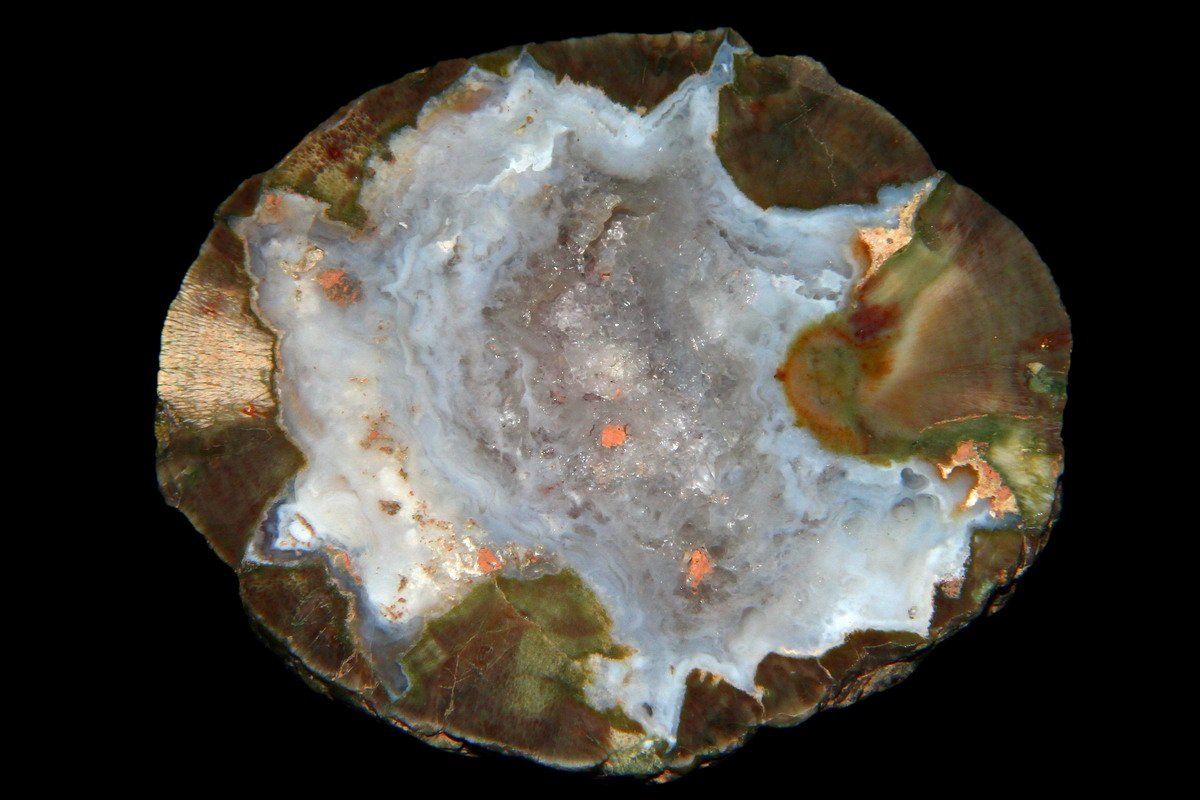
- Thundereggs. Oregon's official state rock. Plain gray-brown spheres on the outside; cut one open and the hollow center can reveal banded agate, plume, moss agate, or opal. You never know until the saw goes through — that's half the fun.
- Owyhee & picture jasper. The region's signature stone — soft blues, tans, and browns that look like miniature desert landscapes when cut and polished. "Picture jasper" earns its name.
- Plume & moss agate. Graveyard Point is famous for plume agate — feathery inclusions suspended in clear chalcedony, often with black dendrites. Prized cutting material.
- Petrified wood. Ancient logs turned to stone, grain and rings preserved. Especially good material in the remote country near Owyhee Lake.
- Chalcedony, opal & quartz. Common opal, milky quartz, and clear-to-blue chalcedony turn up alongside the jaspers. Haystack Butte is known for colorful brecciated jasper.
- Plant fossils. Leaf and plant imprints in old lake-bed and ash deposits are common, and legal to collect. The rule of thumb: plant and shell, yes; bone and tooth, no (more on that below).
What you can't take — and why it matters
A few mistakes out here aren't just bad etiquette; they're federal crimes with real penalties. Keep these straight:
- Vertebrate fossils — bones, teeth, anything with a skeleton — are protected. Collecting them is permit-only, and those permits go to qualified researchers, never to recreational collectors.
- Archaeological and Native artifacts — arrowheads, pottery, beads, anything from a burial — are protected under federal law. Don't pick them up; don't move them. If you find something, leave it and note the location.
- Motorized or mechanized digging. Hand tools only — pick, hammer, chisel, shovel, screen. No heavy equipment, no explosives.
- Anything for resale. Commercial collecting needs a different permit or a mining claim.
Rockhounding the Owyhee at a glance
- Location
- Owyhee canyonlands, Malheur County, southeastern Oregon
- Managed by
- Mostly Bureau of Land Management (BLM); some Oregon State Parks land
- BLM limit
- 25 lb per day + one piece, up to 250 lb per year, per person — personal use
- State park limit
- Succor Creek: 1 gallon/day, 3 gallons/year, per person
- Permit
- None for personal, non-commercial collecting
- Tools
- Hand tools only — no machinery or explosives
- Best season
- Spring and fall (summer heat is severe; roads slick when wet)
- Cell service
- None at most sites — come prepared and self-sufficient
- Cost
- Free to collect on open BLM land
Where to go
All driving times are rough and measured from the Jordan Valley area. Roads out here are mostly unpaved, dusty, and can be impassable when wet — most reward a high-clearance vehicle, and some demand it. Check conditions before you head out.
- Succor Creek Canyon (about an hour north) — the classic. An enormous thunderegg bed plus picture jasper, agate, petrified wood, and plant fossils. Cross the footbridge into the State Natural Area and follow the trails up the hill to dig the rhyolite; the gravel washes and hillsides along the road are BLM and productive too. Remember the two different limits here.
- Leslie Gulch / Owyhee Reservoir (about 90 minutes) — one of the most scenic drives in the state, with thundereggs, jasper, agate, and petrified wood across open ground. Best when the reservoir is low in summer. (See our Leslie Gulch guide for the drive itself.)
- Graveyard Point (northeast, near the Idaho line) — big country celebrated for plume agate with black dendrites. Watch for private and claimed parcels mixed in with the public land.
- Haystack Butte (remote) — colorful brecciated jasper for those willing to make the drive. Treat it as a full-day, well-prepared expedition.
- The country near Owyhee Lake (remote) — excellent petrified wood, with common opal, agate, jasper, and the occasional geode nearby. True backcountry; research access carefully.
What to bring
Half the battle out here is logistics. At most sites there's no gas, no water, and no cell signal for many miles — pack like you're on your own, because you are.
- Tools. Rock pick or geology hammer, cold chisel, a short shovel or sturdy trowel, a screen for the washes, and a spray bottle — wetting a rock reveals its true color and pattern. Bring a bucket and something to wrap specimens.
- Water and fuel. A gallon of water per person per day, minimum. Fill the tank in Jordan Valley — it's the last reliable gas.
- The just-in-case kit. A good spare tire and jack, paper or downloaded offline maps, sun protection, sturdy boots, gloves, and a basic first-aid kit. Tell someone your route and when you'll be back.
Collect like you want it here for the next person
The Owyhee has stayed productive for generations of rockhounds precisely because most of them collected with restraint. Fill in every hole you dig. Pack out all your trash — and any you find. Stay on existing roads and tracks; off-road driving scars the desert for decades and is flat-out prohibited in the state park. Leave gates the way you found them, since much of this is grazing land. And take reasonable amounts, not everything in the wash.
When to go
The sweet spot is spring and fall. Summer in this high desert is brutally hot with no shade and no water near the best sites, and dehydration is a genuine risk — if you go in summer, work the early mornings and evenings and never push past your water supply. The shoulder seasons also tend to have more ground exposed and washes freshly cut by runoff. Avoid the back roads entirely when rain is in the forecast; the dirt turns to slick, impassable mud and closures are common.
Make it part of a bigger trip
A rockhounding run pairs naturally with the rest of the canyonlands. Leslie Gulch doubles as both a collecting area and one of Oregon's most jaw-dropping drives; Owyhee Reservoir is right there for fishing and a swim to wash off the desert; and the dark skies of the Owyhee make the perfect end to a day spent looking down — once the sun sets, look up. Plan a few days and string several together.
Before you go: the fine print
This guide is general information, not legal advice. Rockhounding rules change, mining claims shift, and land boundaries on the ground are rarely marked. Collecting limits and the legal status of the Owyhee canyonlands were accurate to our research as of 2026, but the area's potential national-monument designation in particular remains an open question. Before you collect, confirm current rules and land status with the BLM Vale District Office, and make sure you're not on private land or an active mining claim. When in doubt, leave it where it lies.
Your basecamp for the Owyhees
After a dusty day in the washes, you'll want full hookups, a hot shower, and room to sort and wash your finds. Sunny Ridge RV Park is your gateway to the Owyhee canyonlands, near Jordan Valley, Oregon.
Book Your Stay